

Why I still like web feeds 🔗
I've been a fan of web feeds since the good old Google Reader days. Google Reader was a short-lived, but influential web application from two decades ago, which let you subscribe to your favorite blogs and web articles. Even from today's perspective, this still is a human centered way to consume content on the internet: you subscribe to a publication (like this blog) without giving your e-mail address. It probably died because of its lack of algorithms steering you towards doom scrolling.
Believe it or not, in some corners of the internet, web feed standards like RSS are still a thing, especially in what sometimes is called indieweb. For more than a decade, I have been using Feedbin as a replacement for Google Reader to keep up with internet articles.
So, almost two years ago, I started this blog - "like it's 1999", because digital sovereignty over my own content meant more to me than optimizing for reach like on LinkedIn or Substack. It was also a fun tech project to create my own static website publication. By no means am I a good writer - I write mainly to have a reference for my personal projects and experiments, and to create a record I can point to later.
Newsletter as a form of publication 🔗
Obviously, I cannot force everyone to use web feeds, so I wanted a way to reach people who don't know acronyms like RSS. The solution seems obvious: The newsletter business has exploded in recent years, and everyone has an email address, so a newsletter it is! Even Feedbin now allows you to subscribe to newsletters in addition to web feeds.
In the past, I have used Mailchimp when organizing GeoBeer and evaluated different existing newsletter services, but most were ridiculously expensive for the handful of subscribers I expect.
Creating my own newsletter framework 🔗
So back in early 2025, I built ping13/listmonk-rss, a simple tool that turns RSS feeds into newsletters using Listmonk with no dependency other than GitHub Actions and Listmonk itself. The setup lets me publish once and reach both web feed users and email subscribers, on my own terms, with full control. The whole workflow is described in the following diagram:
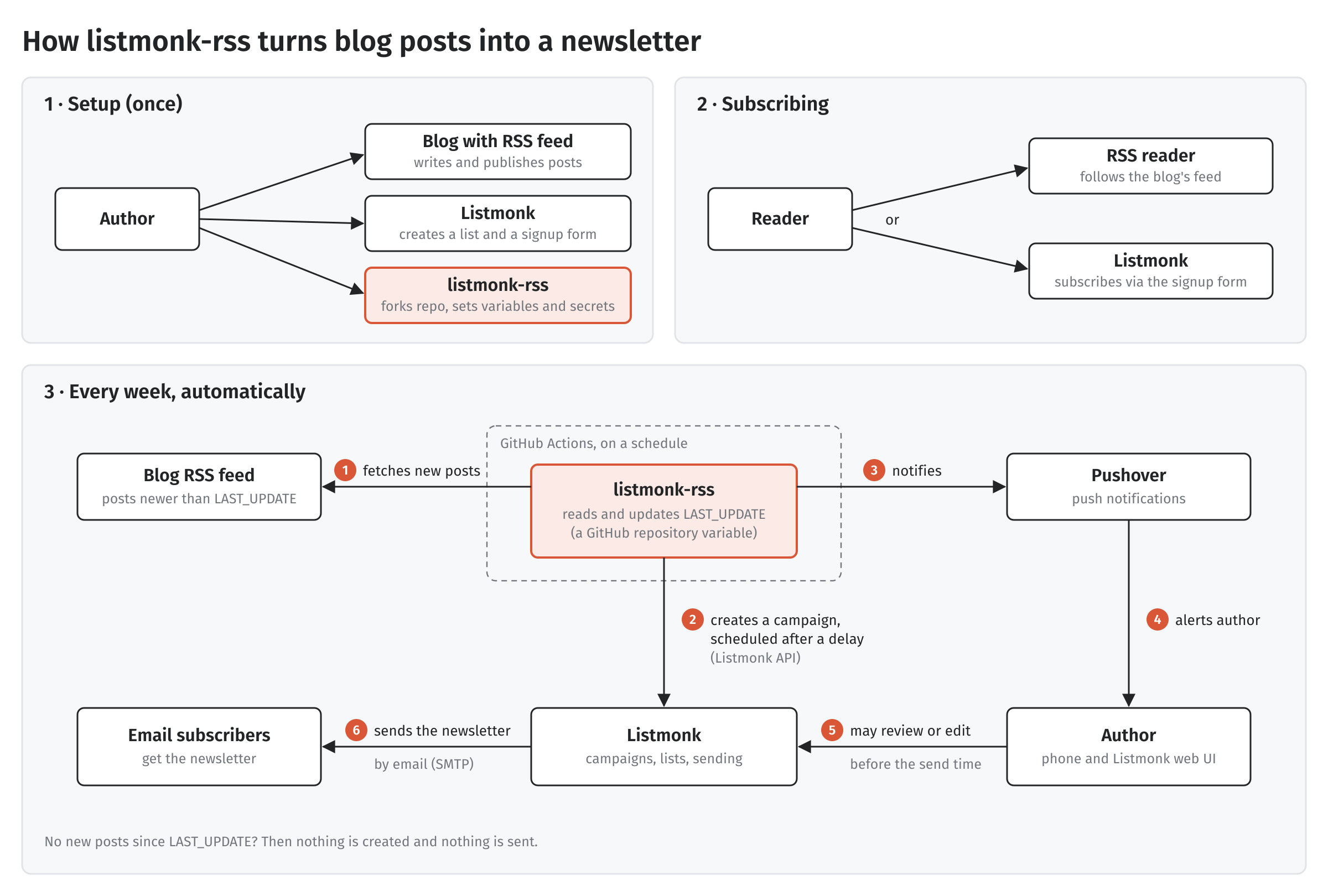
Today, I finally updated the code base from almost two years ago based on feedback from users. If you are interested in technical details of the implementation, see the C4 architecture diagrams of listmonk-rss.
There is hope for simple standards 🔗
If you still believe in the open web, or just want a simpler way to share and read, web feeds are still here. To some extent, my hope is that they will see a revival eventually, because open standards based on plain text are easily automatable and consumed by AI, just like Markdown has taken over the world, not only due to its ease of consumption by AI.
And finally, don't forget to subscribe to my blog via web feed or newsletter.