

The speed-of-light innovation in AI 🔗
When I heard about Nano Banana (Pro), the latest image generation model by Google, a couple of weeks ago, I had a recurring thought: "Oh well, yet another AI tool, how can I possibly stay up-to-date with all these tools?" Even with enormously helpful blogs like the one by Simon Willison, it is hard as an engineer to keep up with the technological advances.
A side note: This pace is powered by money. Global AI investment already runs into the hundreds of billions; in just the first half of 2025, EY estimated $50 billion. And that’s before you count the hidden spend—bloated cloud bills, repackaged data-center capex, internal R&D nobody reports, and the efficiency losses from companies racing not to be the one that “missed AI.”
Infographics with Nano Banana 🔗
Back to Nano Banana. To me, it was one of many surprising milestones in the past year; its cutting-edge multi-modal capabilities allow for powerful image manipulation, including making nice-looking infographics from text prompts. With just a few sentences, I got an IKEA-style manual for creating a 3D printed model—it even renamed my service to “Töpoprint.” Click the triangle below to see the prompt I used and the result.
Example: A prompt for a Topoprint infographic
Draw a nice infographic in the style of IKEA about Topoprint, a web service for creating 3D prints. Please use all the information of the posts listed on this web blog: https://blog.heuel.org/tag/topoprint/. Read them carefully before creating the infographic.
Show the following steps
1. access topoprint.ch
2. design your Topodisc
2a. Find a Swiss location: Search or zoom on the map.
2b. Place a disc: Click the map to add a disc. Drag the center of the disc to position it.
2c. Adjust size: Use the slider to change the coverage of the disc. A larger print size increases your coverage (but also your processing and printing costs).
2d. Personalize your Topodisc with a dedicated label.
2e. Create it: Click "Create Topodisc" and wait a few minutes.
3. Choose to print it yourself or send it to a printing service
4. finish and collect your model

Switching perspectives on AI 🔗
Personally, I am stuck between essentially four different perspectives about AI (which is nowadays mostly generative AI):
- local perspective: "AI is just an inherently unpredictable slot machine."
- pragmatic perspective: "Oh, this is so useful and will save me hours!"
- meta perspective: "OMG, this is all mind-blowing and changes everything!!1!"
The last view is overly positive and, I think, a naive one, which for me eventually turns into a very pessimistic version, the fourth view:
- doomsday perspective: "We are all in a Black Mirror episode", as it becomes clear what kind of evil things generative AI enables because it's so unpredictable and people don't use the tools with care: "flooding the system with slop", "no accountability for anything", "bullshit-as-a-service", "Concentrated power/control in a few vendors’ closed models", "data leakage, security risks" ... The list goes on and on, scary times.
After a couple of days of being mind-blown and scared at the same time, I get used to it and spot where the AI tools fail, like the animal alphabet poster that fails even for Nano Banana Pro. So the engineer in me is saying: "Oh well, in the end, this is a stochastic machine on an unfathomable amount of data. Errors arise and creativity is an accident." And I am back to the local perspective, completing the emotional loop.
In a totally ironic move, I tried to express this emotional loop about AI in an infographic with a prompt that resembled the text above:
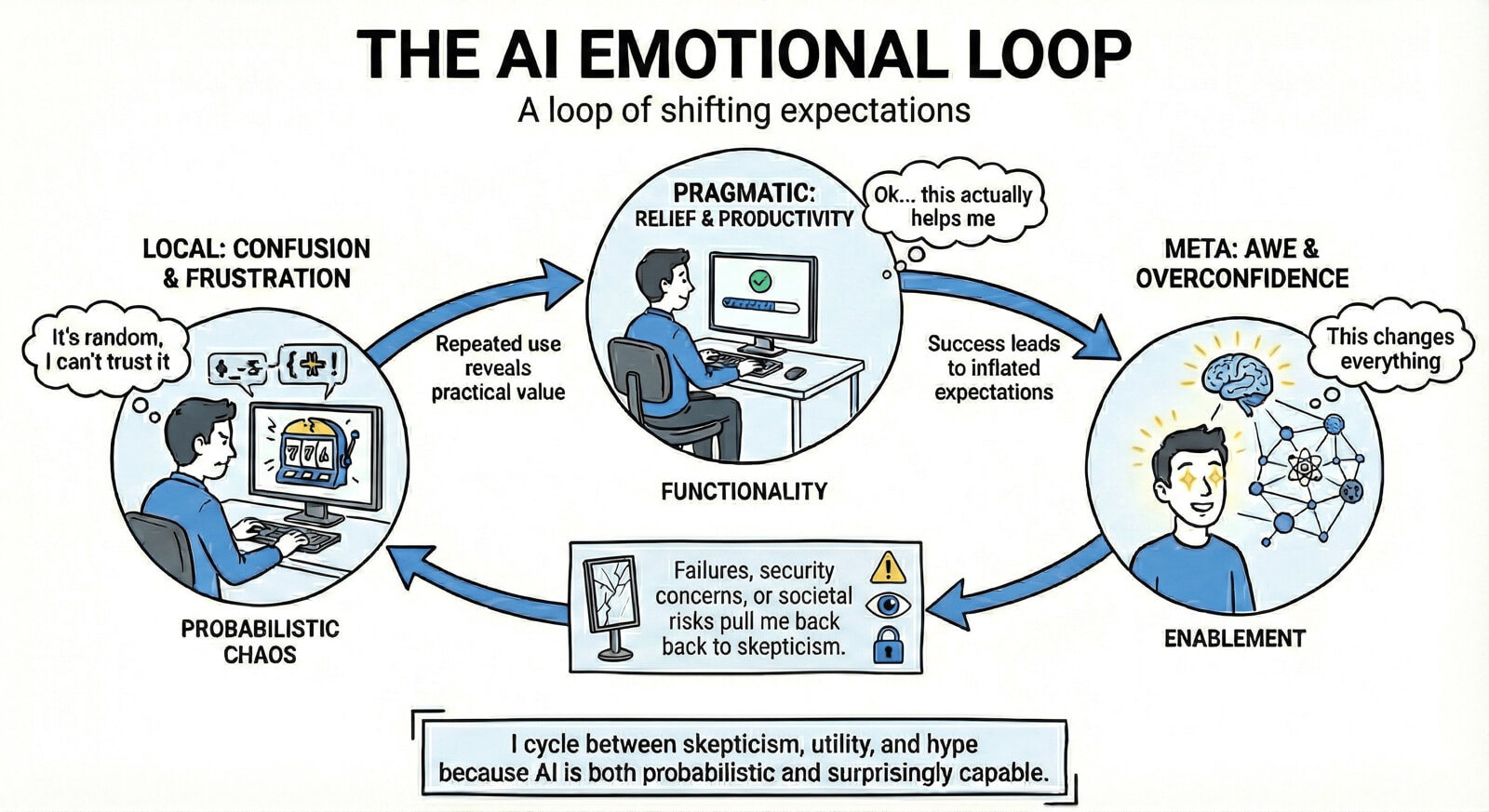
Unfortunately, I don't have a tidy ending for this loop or this post. It's an ongoing state and I am not sure where this ends—maybe the only thing to do is notice the loop, be decent, stay alert, keep experimenting, and stay accountable for the work you produce.
Stay Connected 🔗
Thanks for reading this! If you like, subscribe for more content. I also would love to hear from you: Feel free to get in touch with me!