
Earlier this year, I co-founded Resilens, and we have been quite busy the last months. It's a joy to work with old and new friends and we are convinced we are building something meaningful. And while we are bootstrapping ourselves into existence, speed is of the essence: the time and bandwidth of a few team members is the scarcest resource we have.
That scarcity has made me think harder about how I create things: when to do the work myself, when to hand it off, and when to let AI take a first pass. This post picks up a thread from an earlier one about human creativity and AI.
The Grind and the Joy 🔗
For the sake of this post, assume two modes when creating something new.
Sometimes you really are not interested in the result, you just need to get it done. It might be a legal document you need to draft, or a letter to your local administration. You are not attached to the process or the result; you just want it done. Let's call this mode grind2.
But if you really care about something, you are not only interested in the result of the process — you are genuinely interested in being part of the process. Let's call this mode joy3.
What's grind and what's joy is obviously very subjective. My daughters cannot understand why I am so fascinated by any kind of tech-nerdery. On the other hand, I am not a person who sees his destiny in accounting, although I know people who do enjoy keeping financial numbers in order.
And of course, life can't be all joy — as we say in German, Das Leben ist kein Ponyhof ("life is no pony farm"). Every day you face tasks somewhere between the two modes; it's rarely black and white. You could even trick yourself through grind work by making it more fun, like listening to an audiobook while doing the dishes.
Three Ways to Start in the Age of AI 🔗
Until recently, starting a task meant one of two things: do it yourself, or ask another person. AI1 adds a third option — fast, cheap, always available — and the temptation is to reach for it everywhere, grind and joy alike.
I want to recommend Christoph Niemann's visual essay about the creative process4. This quote stayed with me:
Creating art is a nonlinear process. I start with a rough goal. But then I head into dead ends and get lost or stuck. The secret to my process is to be on high alert in this deep jungle for unexpected twists and turns, because this is where a new idea is born. I can’t make art when I’m excluded from the most crucial moments.
Niemann's worry is being excluded from the crucial moments. That is exactly the choice AI now puts in front of me. Faced with such a task, I notice three starting points:
- Vibing: I delegate to AI first and only minimally interact until I say, "eh, good enough". I deliberately exclude myself from the creative process.
- Crafting: I start working myself and may use AI only for critique, options, or improvements, because I care about the creative process and want to own it.
- Commissioning: I ask another human to create something, because I want their taste, skill, judgment, or care in the work.
Vibing and crafting are about how I relate to my own work. Commissioning is different in kind — it hands the work to someone else — so I treat it separately, after the matrix below.
When to Vibe, When to Craft 🔗
To decide when to vibe and when to craft, I came up with the following matrix.
| 🤖 Vibing | 🎨 Crafting | |
|---|---|---|
| 🧾 Grind | ✅ Yes, with verification — Let the machine draft, sort, summarize, or automate the chore. But the final judgment must stay with you, the human. | ⚠️ Only if needed — Sometimes you have no choice: cost, privacy, trust, access, or responsibility keep the work on your desk. |
| ✨ Joy | 🚫 No — This is the trap. You outsource the joy, miss the chance to grow, and risk losing the judgment needed to spot flawed results. | ✅ Yes — The mode that keeps you in flow and in touch with your work. This is where taste, expertise, and joy grow. |
The most dangerous case is vibing the work you actually care about. It feels efficient and if you are under time pressure, you are really tempted to do so. But if the work is your joy work, the process is the point: skip it and you have not saved time, you have thrown away the part you wanted. The detours and dead ends are also where judgment grows, so vibe them away often enough and you erode the very taste you would need to tell a good result from a hollow one. The erosion of judgment becomes especially dangerous in my own field: write code this way and you pile on what is now called cognitive debt, which has affected real world systems already.
This does not mean avoiding AI on work you care about: vibing and crafting are a spectrum, it's not black and white. You can still own a process and work with an AI agent participate; the trap is not using AI, but delegating until no crucial moment is left for you.
The second most dangerous case is vibing the grind without verifying the result. As a friend reminded me: if you specify the work vaguely, you should not be surprised when the output is vague or simply wrong (garbage in, garbage out). The machine can help you move faster, but you still need enough understanding to check the result; otherwise you only automate the route to embarrassing yourself.
A Third Way: Commissioning 🔗
Commissioning does not fit into this matrix: Grind and joy are subjective and describe my own relationship to my work. The moment I "commission" someone, the question is no longer mine to answer: I am trusting or hoping that what feels like grind to me is craft to them. That is also why commissioning is not the same as delegating to AI. As I argued in Yes, Yes And, human-to-human interaction has a magic of its own — you are not only buying output, you are inviting another person's taste, care, and judgment into the result.
Conclusion 🔗
These are my thoughts on grind and joy in the age of AI. All of the above may seem obvious. Good for you! It continues to be something I think about daily — especially in a phase where speed matters and attention is scarce. So my motto nowadays is:
Vibe the grind, verify the result.
Craft the joy, stay in the process.
What do you think? Don't hesitate to share your feedback with me.
Colophon 🔗
You may wonder how this post was written. I thought about the matrix while travelling and jotted down notes on my phone. Later, at my laptop, I drafted the paragraphs. Then I asked Claude Code to critique the draft: it not only caught grammar mistakes but also pushed back where the writing was weak, while I kept editing in my own editor. So this post is itself joy work — crafted by me, with AI for critique.
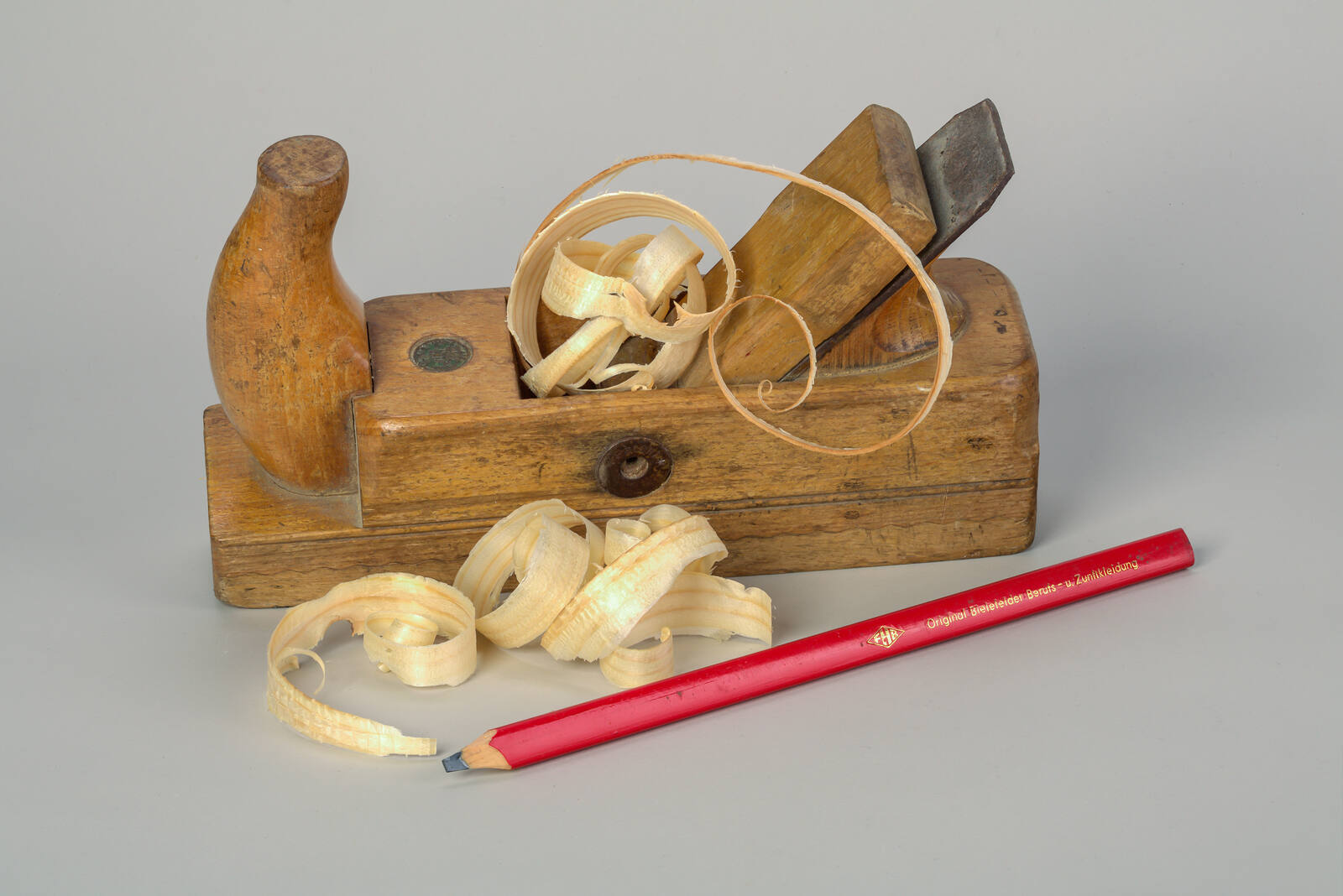
Cover photo: hand plane with wood shavings and a carpenter's pencil by CEphoto, Uwe Aranas, licensed under CC BY-SA 3.0.

-
By "AI" I mostly mean today's generative AI — the revolution that started almost ten years ago with the seminal paper Attention is all you need. ↩
-
There are related terms — Google's Site Reliability Engineering book speaks of toil, Cal Newport of shallow work — but both judge the work as objectively low-value. My grind is relational instead: what is grind to me may well be someone else's joy. ↩
-
On a recent podcast by John Gruber, I caught the quote "The joy of creating something is to be part of the process.", which I really like. The classic name here is flow (Mihály Csíkszentmihályi). ↩
-
It's worth paying for this article, which is best consumed in its original form. Of course, I would never recommend using services like https://removepaywalls.com other than to preview what you will see. ↩